
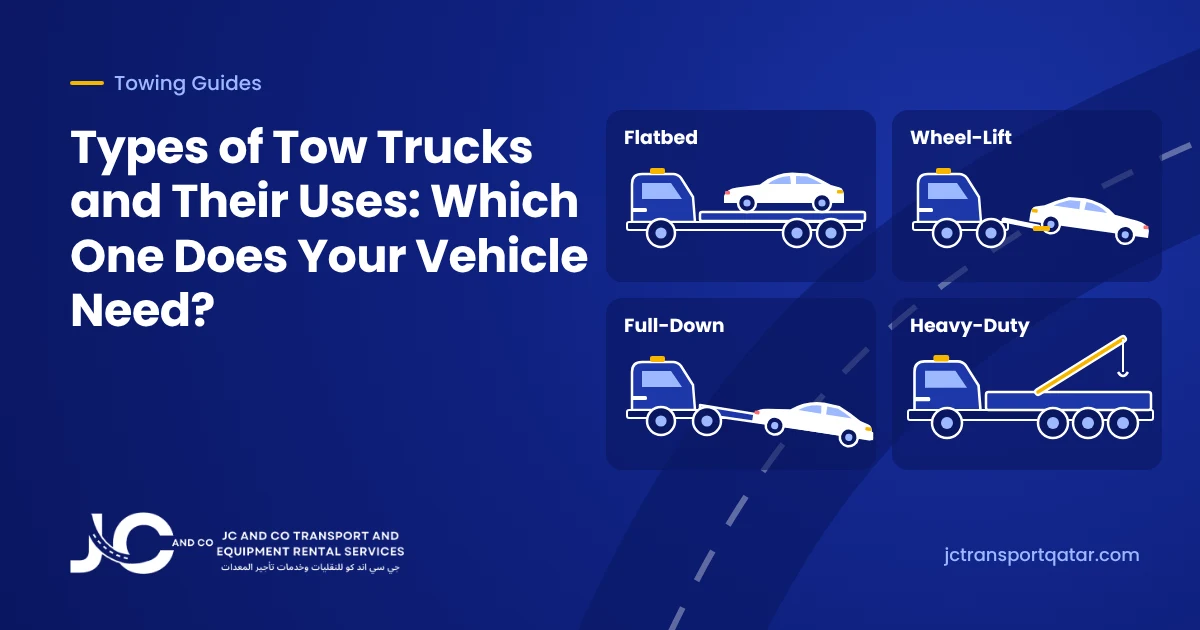
The main types of tow trucks include flatbed, wheel-lift, heavy-duty recovery, low-clearance, and covered tow trucks. Flatbeds carry the entire vehicle on a platform and are suitable for luxury cars, AWD vehicles, and EVs. Wheel-lift trucks are useful for short local tows of standard cars. Heavy-duty recovery trucks handle buses, trucks, and machinery, while low-clearance units recover vehicles from basement car parks. The right truck depends on your vehicle’s drivetrain, ground clearance, size, and location.
Not sure which truck you need? 📞 Call Now | 💬 WhatsApp Us Now
Not all tow trucks are designed for the same job. Different vehicles and recovery situations require different types of towing equipment. Using the wrong truck can damage your vehicle.
A flatbed, wheel-lift, and heavy-duty recovery truck each serve a different purpose. An AWD SUV, luxury sports car, bus, and car stuck in a basement all need suitable equipment and handling.
This guide explains the main types of tow trucks, what each one is used for, and how to choose a towing provider with the right equipment.
How Do Tow Truck Types Differ?
| Type | How it works | Best for | Watch out for |
|---|---|---|---|
| Flatbed | The vehicle is loaded fully onto a platform | Luxury, AWD/4WD, EVs, damaged cars | Long truck; limited access in tight spaces |
| Wheel-lift | Lifts the front or rear wheels while two remain on the road | Standard cars, short local tows | AWD, EV and low-clearance cars may need a different method |
| Heavy-duty recovery | Uses high-capacity lifting and winching equipment | Trucks, buses, vans, machinery | Usually unnecessary for small cars |
| Low-clearance unit | Compact design for areas with low ceilings | Basement and underground parking | Access must be checked first |
| Covered transport | Carries the vehicle inside an enclosed carrier | High-value cars needing dust and sun protection | May require advance booking |
The main differences are how the vehicle is lifted, whether its wheels remain on the road, and the size and access requirements of the job.
The Main Types of Tow Trucks and What They're Used For
Flatbed Tow Trucks: Best for Luxury, AWD, EVs and Damaged Cars
A flatbed tow truck uses a hydraulic platform that tilts down to ground level. The vehicle is driven or winched fully onto the platform, keeping all four wheels off the road during transport.
This reduces drivetrain strain and the risk of scraping. Flatbed towing is generally preferred for AWD, EVs, sports cars, and accident-damaged vehicles when the vehicle’s condition and manufacturer guidance require it.
See our guide on flatbed towing for luxury cars.
Wheel-Lift Tow Trucks: Quick Recovery for Standard Cars
A wheel-lift tow truck uses a hydraulic yoke to lift either the front or rear wheels. The other two wheels remain on the road.
This method is quick and can work well for standard front-wheel-drive or rear-wheel-drive cars on short tows. However, it may not be suitable for AWD, EVs, or low-clearance cars unless the vehicle’s towing requirements are met.
Read our full guide on flatbed vs. wheel-lift.
Heavy-Duty Tow Trucks: Trucks, Buses and Equipment
Heavy-duty tow trucks are designed to recover vehicles that standard towing trucks cannot handle. They have greater lifting and winching capacity for lorries, buses, and construction machinery.
These trucks are also useful for moving heavy equipment between locations. Explore our Heavy Duty Towing and Equipment Transportation services.
Low-Clearance Trucks: Basement and Underground Parking
Standard tow trucks are often too tall to enter basement car parks. Low-clearance trucks are designed to work in these restricted spaces.
They help operators recover vehicles from underground parking areas with low ceilings, tight turns, and narrow ramps.
Read our guide on how basement towing works or visit our Basement Towing service page.
Covered Tow Trucks: Dust and Sun Protection
Covered tow trucks carry vehicles inside an enclosed space. This protects them from direct sunlight, dust, and road debris during transport.
In Qatar, covered transport can be useful for luxury and high-value cars that need additional protection from dust, sun, and sandstorms.
Explore our Covered Tow Truck service and read about covered vs. full-down towing.
Dollies and Full-Down Towing: Immobilised Vehicles
Some vehicles cannot roll or steer because their wheels are locked or their systems are immobilised. In these cases, wheel dollies can help move the vehicle without allowing the affected wheels to roll on the road.
For vehicles that require all four wheels to remain off the ground, a suitable four-wheel dolly setup may be used when compatible with the vehicle and recovery conditions. A partial dolly setup may not be suitable for every vehicle.
Learn more about our Full Down Tow Truck service and read our EV towing guide.
Which Tow Truck Does Your Vehicle Need?
| Your vehicle | Best option |
|---|---|
| Standard FWD/RWD car, short tow | Wheel-lift or flatbed |
| AWD/4WD, EV, luxury, sports or classic car | Flatbed; a suitable four-wheel dolly setup may be used for certain immobilised vehicles |
| Car stuck in a basement | Low-clearance unit |
| Truck, bus, van or machinery | Heavy-duty recovery |
| Premium car needing dust and sun protection | Covered transport |
Not sure which truck your vehicle needs? Tell the towing company your car’s make, model, drivetrain, and location. A professional team can assess the details and confirm the suitable truck before dispatch.
If your car has a dead battery or flat tyre, Roadside Assistance may resolve the problem without towing. If your vehicle has been in an accident, explore our Car Recovery service.
Why One Truck Isn't Enough: What a Professional Towing Company Carries
A freelance driver may have only one truck and one towing method. This may not be suitable for every vehicle or recovery situation.
A professional towing company can provide a wider range of equipment, trained operators, proper documentation, and backup capacity. If one truck is already handling another job, another suitable vehicle may be available.
Having different types of tow trucks helps the company match the equipment to the vehicle instead of using the same method for every job.
Read our guides on towing company vs. freelance driver and how to choose a reliable towing company.
What Fleets and Businesses Should Look for in a Towing Partner
For fleets, dealerships, contractors, and property managers, towing is often an ongoing requirement. Choosing a provider with the right equipment and capacity helps support these needs.
Look for:
- Equipment for your entire fleet: The provider should be able to handle different vehicle types, not just one category.
- Consistent handling: Every vehicle should receive suitable equipment and careful handling.
- Clear invoicing and flexible business payment terms: These help businesses manage service costs and records.
- Capacity across multiple sites: The provider should be able to support towing requirements at different locations.
- One point of contact: A dedicated contact makes ongoing coordination easier.
To discuss long-term towing coverage for your business: 💬 WhatsApp Us | info@jctransportqatar.com
Frequently Asked Questions
The main types include flatbed, wheel-lift, integrated/boom, heavy-duty recovery, low-clearance, and covered tow trucks. Dollies are also used to move certain immobilized vehicles safely.
A flatbed is a suitable choice for many vehicles because it keeps all four wheels off the road. Wheel-lift towing can also be appropriate for standard cars on short tows when the vehicle’s requirements allow it.
A flatbed is generally preferred for luxury and sports cars because it reduces the risk of scraping and keeps the wheels off the road. Covered transport can provide additional protection from dust and sunlight.
Flatbed towing is generally preferred for AWD and 4WD vehicles because it keeps all four wheels off the road. Wheel-lift towing may create drivetrain risks if it is not suitable for the vehicle.
Usually not. Many basement car parks have limited entrance height and tight access. A low-clearance unit is designed to handle these conditions.
A heavy-duty recovery truck is used for buses, trucks, and large machinery. It has the lifting and winching capacity needed to handle heavier vehicles.
JC & CO operates light, medium, and heavy-duty towing vehicles, along with specialised recovery units. Its services cover flatbed, covered, full-down, basement, EV, and equipment transportation needs, subject to the vehicle and recovery requirements.
Every Tow Type, One Professional Team: JC & CO
The right tow truck depends on the vehicle and the recovery situation. JC & CO Transport and Equipment Rental Services is a structured, professional towing company, not a one-truck operation.
Founded by mechanical engineer, JC & CO assesses each job before dispatch and provides trained operators and proper documentation. Its fleet includes different towing vehicles and specialised recovery units to support a wide range of towing requirements.
JC & CO serves individual drivers and long-term business partners across Qatar, backed by two generations of towing expertise.
